Combinatorics and Exploitative Poker Strategy
Understanding poker mathematics is essential when evaluating an opponent’s range and deciding how to play against it.
One of the most useful mathematical concepts in exploitative poker is combinatorics — counting the number of possible combinations of cards an opponent can hold.
Knowing how many combinations of different hands are possible helps us estimate the composition of an opponent’s range. More importantly, it helps us construct betting lines designed to maximise profits against that range.
The objective is not to perform complicated calculations while playing. It is to understand the mathematics away from the table so that we can make better decisions when similar situations arise.
Pre-Flop Hand Combinations
Before the flop, the number of possible combinations of any particular starting hand depends on whether the hand is paired, suited or unsuited.
Unpaired Hands — 16 Combinations

Consider a starting hand such as Ace-King (AK).
There are four aces and four kings in the deck.
4 × 4 = 16 combinations
Therefore, there are 16 possible combinations of AK before any cards are removed from consideration.
Of these, four combinations are suited and twelve are offsuit.
The same principle applies to any two different ranks, such as KJ or 93.
Pocket Pairs — 6 Combinations

Pocket pairs have fewer possible combinations.
Consider pocket aces (AA).
There are four aces in the deck. Once one ace is selected, three remain.
Multiplying four by three gives twelve, but this counts each combination twice because reversing the order of the two cards does not produce a different hand.
Therefore:
(4 × 3) ÷ 2 = 6 combinations
Every pocket pair has six possible combinations before accounting for any known cards.
Specific Suited Hands — 1 Combination

A specific suited hand has only one possible combination.
For example, A♣K♣ is one combination.
There are four possible suited combinations of AK in total, one for each suit.
These distinctions become particularly important when estimating how frequently an opponent can hold particular types of hands.
Post-Flop Hand Combinations
The number of possible combinations changes when community cards appear.
This is because an opponent cannot hold cards that are already visible on the board.
One-Pair Hands
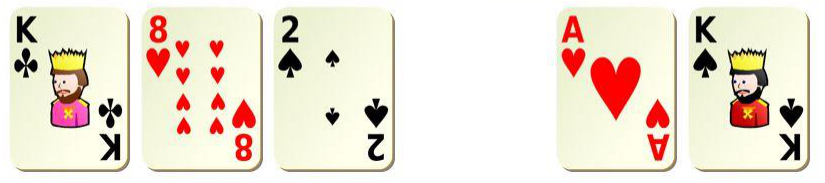
Suppose your opponent could have AK and the flop contains a king.
Before the flop, AK has 16 possible combinations.
However, one king is now on the board, leaving only three kings available.
There are still four aces available, assuming no ace is visible or otherwise known.
Therefore:
4 × 3 = 12 combinations
The number of possible AK combinations has fallen from sixteen to twelve.
This illustrates how community cards reduce the number of hands an opponent can hold.
Sets — 3 Combinations
Suppose the flop is:
K♣ 9♥ 2♠
Your opponent might have pocket nines and therefore a set.
However, because one nine is on the board, only three nines remain available.
The number of possible combinations of pocket nines is:
(3 × 2) ÷ 2 = 3 combinations
Therefore, there are only three possible combinations of a set of nines.
This is important because an opponent may have considerably fewer combinations of very strong hands than weaker hands.
Putting Your Opponent on a Range
The practical value of combinatorics becomes apparent when we use it to evaluate an opponent’s likely range.
Against very tight players, sometimes referred to as NITs, it may be possible to assign a relatively narrow range.
For example, a particularly tight opponent might frequently enter pots with pocket pairs, AK and AQ.
However, their actual pre-flop raising and cold-calling frequencies must be considered. We should not automatically assume that every tight player holds exactly the same range.
Against opponents who play a much wider selection of starting hands, attempting to identify an exact hand is generally less useful.
Instead, we can group their possible hands into categories and use their post-flop responses to estimate the strength of their ranges.
When You Have Top Pair, Top Kicker
Suppose you hold top pair with the best possible kicker.
You can divide your opponent’s range into five broad categories:
- Two pair or better.
- Overpairs.
- Top pair with a weaker kicker.
- Pocket pairs below top pair or middle pair.
- Drawing hands.
The objective is to determine approximately how much of your opponent’s range belongs to each category.
When You Have Top Pair, Middle Kicker
When your kicker is less secure, the distinction between better and worse top-pair hands becomes more important.
You can divide the opponent’s range into six categories:
- Two pair or better.
- Overpairs.
- Top pair with a better kicker.
- Top pair with a worse kicker.
- Pocket pairs below top pair or middle pair.
- Drawing hands.
These categories provide a practical framework for analysing the profitability of different betting decisions.
The precise categories will depend on the board and the opponent’s likely starting range.
Using Combinatorics to Construct Betting Lines
The purpose of dividing an opponent’s range into categories is to develop betting lines that maximise expected profits against the range as a whole.
This analysis should generally be completed away from the table.
We want to consider how different betting actions and bet sizes perform against each part of an opponent’s range.
For example:
- How much might we lose against stronger hands?
- How much value can we extract from weaker hands?
- Which hands will call different bet sizes?
- If we are bluffing, how much of the opponent’s range is likely to fold?
The important consideration is not simply whether an opponent could have a particular hand.
It is how frequently that hand is likely to occur within their overall range.
Playing Against Tight Opponents
Suppose there is a flush draw on the board and we are playing against a very tight opponent.
If their pre-flop range consists primarily of pocket pairs, AK and AQ, they may have relatively few suited combinations capable of making a flush draw.
There may be substantially more combinations of pocket pairs and AK or AQ in their range.
In this situation, our primary objective should be to construct a betting line that performs profitably against the largest portions of their range.
We should remain aware of possible draws, but we should not allow a relatively small part of the range to dominate our decisions.
Playing Against Loose Opponents
Against opponents who enter pots with a wide range of hands, the situation may be very different.
Their ranges can contain more draws, weak top pairs and lower pairs.
Consequently, there may be opportunities to extract value from a much wider selection of weaker hands.
The appropriate betting line will depend on how frequently the opponent calls, raises or folds with these different categories.
The objective remains the same: exploit the weaknesses in the opponent’s range rather than treating every possible hand as equally likely.
Using Betting Actions to Narrow an Opponent’s Range
Sometimes a betting action can help narrow an opponent’s likely range and make later decisions easier.
For example, suppose we bet half the pot on a draw-heavy board and our opponent calls.
Against certain opponents who frequently raise strong hands to protect against draws, a call may make two pair or better less likely.
This can help us estimate the range we are facing on the next street.
However, the interpretation depends on the opponent. Some players slow-play strong hands, while others raise draws aggressively.
We should therefore use observed behaviour rather than assume that a particular action always represents the same hand strength.
Bringing the Mathematics Together
Combinatorics is not simply about memorising that unpaired hands have sixteen combinations or that pocket pairs have six.
Its real value lies in understanding the composition of an opponent’s range.
When constructing a betting line, we need to consider the number of combinations in each hand category, how those hands respond to different actions and how much we can expect to win or lose.
Most of this work should be completed away from the table.
The objective is to develop a clear understanding of how to approach particular situations, so that the appropriate betting lines become familiar through study and experience.
In exploitative poker, the mathematics is a means to an end: identifying opponents’ weaknesses and making decisions that maximise expected value against their ranges.